



How to Sue for Due Process of Law
Summary
It is a waste of time to ask any state judge to admit 35+ years of predatory fraud and discrimination against veterans, so we need to ask the federal court to hold the state judge accountable for the violation of due process. This begins under the Fourteenth Amendment and 42 U.S.C. § 1983.
The Enforcement Law

Section 1983 opens the door to Federal Enforcement of Due Process. It was written in 1871 to deal with racism by judges and other officials, but it applies whenever state actors violate Federal Rights. This is the "Remedy" to enforce "Rights" protected by the Fourteenth Amendment to the Constitution.
- Where they have "subject matter jurisdiction," they have "Immunity" from any suit for money or just to harass them and we can only sue to make them follow due process of law. If we can prove the violation of rights, most courts are required by Rules to assign the case to a new judge who is not biased or inclined to repeat the violation.
- Where they have NO possibility of "subject matter jurisdiction" on the rights they violate, they have NO Immunity for those violations. They can be sued for money.
The difference is between the
"lack of subject matter jurisdiction at the moment"
vs.
"the complete absence of all subject matter jurisdiction EVER."
The Question of "Immunity" is answered by the "Federal Preemption of State Jurisdiction" which removes Judicial Immunity by preventing "concurrent jurisdiction" on the federal subject matter.
The Constitution and Laws of the United States control every aspect of "Subject Matter Jurisdiction" on federal rights established by Title 10 military service and Title 38 veteran benefits.
The Question of Immunity is Answered by Federal Preemption
It is very hard to sue a judge for money because they have “Immunity” for //almost// everything they do.
On the other hand, it is not hard to sue for due process because Immunity has nothing to do with federal Enforcement by Declaratory or Injunctive Relief.
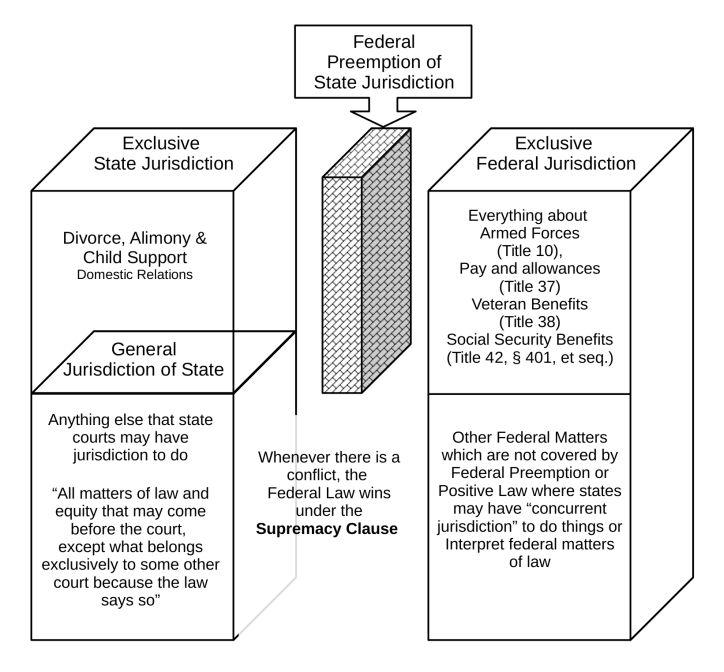
Immunity ONLY applies to a suit demanding “judgments for money” and ONLY applies when the state judge is doing something within the usual "box" of jurisdiction that belongs to the court where they work. That box is defined by state law, which usually says “all cases of law or equity, except when the law says it belongs exclusively to some other court.”
Federal Preemption means that the subject matter belongs exclusively to the Federal Court before any state law can touch it.
"Concurrent Jurisdiction" is the idea that state courts hold jurisdiction to "interpret" federal law, which means "to cherry-pick whatever federal laws they like." Whenever state judges claim to hold "concurrent jurisdiction" on veteran benefits, whether they cite Rose v. Rose or not, it is a "smoke and mirror" show to hide their violation of Federal Preemption.
When they commit this act of fraud to cross the line of federal preemption, they cancel their own immunity. Every time they cite Rose v. Rose to claim jurisdiction, they commit the violation of federal preemption. The difference between the Complete Federal Preemption expressed in the plain text of positive law 38 U.S.C. §511 pursuant to Article I § 8 of the Constitution and quotations taken out of context from Rose v. Rose is that § 511 is the supreme law of the land and Rose is NOT.
It does not matter whether they have issued orders to make or enforce alimony or child support. The moment they claim to have jurisdiction on veteran benefits, combat related special compensation or social security benefits, they cross the line of federal preemption and forfeit their immunity.
More on Federal Preemption and Positive Law ...
Connecting the Dots

In order to bring a federal suit against a state judge under the Fourteenth Amendment, we need to be really clear about what federal right the judge has violated. See the list of Federal Rights Often Violated by state judges.
- This is not about any orders made by the judge within the jurisdiction he has.
- This is about the violation of federal rights by the extraction of money from veteran benefits which the judge has NO possibility of jurisdiction to do.
Example:
| UNITED STATES DISTRICT COURT | |
| Veteran _______, Pro Se Plaintiff, v. Judge ______________ Defendant | Case No. ____________ |
On ___________ (date(s)), in the ______________(state) courtroom, this defendant judge violated my 38 U.S.C. § 5301 right to protection of my VA benefits from "any legal or equitable process whatever, either before or after receipt" which is further protected under the complete federal preemption of state jurisdiction established by the plain text of positive law 38 U.S.C. § 511 pursuant to the Constitution.
According to Article VI of the Constitution, positive law 1 U.S.C. §204, and the complete preemption expressed in positive law 38 U.S.C. §511, whenever there is any question about whether state judges are Required to take 38 U.S.C. § 5301 literally at face value and OBEY it, that question belongs exclusively to the Secretary of the VA and ONLY specific federal courts.
Relief:
- Declaratory Judgment confirming federal preemption and finding that the Defendant Judge violated it.
- Punitive Judgment for the irreparable harm caused by his actions in the complete absence of all jurisdiction on the subject matter of the Rights he has violated. See Bradley v. Fisher, 80 U.S. 335 (1871) , et al.
This is not a fill in the blank template.
It is just an example.
Contact us about what you need to file your own Complaint.
In other words, 38 U.S.C. § 5301 says that veteran benefits cannot be touched by ANY legal or equitable process, not even for alimony or child support because 38 U.S.C. § 511 is PROOF of Congressional Intent to protect veterans by preempting state jurisdiction.
The state judge broke the federal law that makes veteran benefits exempt from state jurisdiction under any circumstances.
State judges have jurisdiction on the subject matter of divorce, alimony and child support, but the supreme law of the land makes it clear that state judges have NO possibility of jurisdiction on the subject matter of Title 38. Where they have NO subject matter jurisdiction, they have NO immunity for the violation of rights.
What to Expect
 The Federal District Courts are going to do one of two things, either stop us at the door by refusing to issue the summons to the Defendant judge, or issue the summons and dismiss the case. They might say our Complaint is an appeal of the state court order, or they might say the state judge has "absolute immunity" for anything he does, but that is not quite right.
Judicial Immunity boils down to one single thing, potential jurisdiction on the subject matter of the rights he is violating. Actions that are NOT within the jurisdiction of the court where he works, e.g. Veteran benefits, are NOT judicial actions. He has NO immunity where he has NO possibility of jurisdiction on the subject matter of the rights he has violated.
Since we are fighting over 35 years of systematic predatory corruption, we are going to need the Supreme Court of the United States to issue a decision on the following Constitutional Questions:
Are state judges REQUIRED to OBEY the Complete Federal Preemption expressed in the plain text of current positive law 38 U.S.C. § 511 and implied by the nature of Title 38 pursuant to Article I § 8 of the Constitution?
The ONLY real answer is
"Yes! Of course they are because the Supremacy Clause says that state judges are automatically bound by federal law pursuant to the Constitution."
The lower federal courts understand that these questions put them into a difficult position.
- Answering the question correctly by saying "Yes" would disrupt some paychecks for local state judges and lawyers by exposing the misconduct in their violations of due process.
- Answering the questions by saying "No" would get the federal judges in trouble for violating due process by going against the Constitution.
This is very simple to understand:
Complete Preemption was established by the Veterans Judicial Review Act (VJRA) Pub. Law 100-687 (1988) which closed the § 211 loopholes described in Rose v. Rose, thereby closed every other loophole created by Rose.
Section 511 makes it clear state judges could not possibly hold jurisdiction to extract any money from veteran benefits by property division in divorce, or support orders, garnishment, contempt or even jail.
That means, ... we can sue them for money because of the damage they do to our families.

If you have suffered hardship by the corruption and profiteering on veteran benefits in state court, or hardship after losing a veteran to suicide caused by that predatory fraud, please contact us for more information about how to get those corrupt lawyers and judges in trouble.